
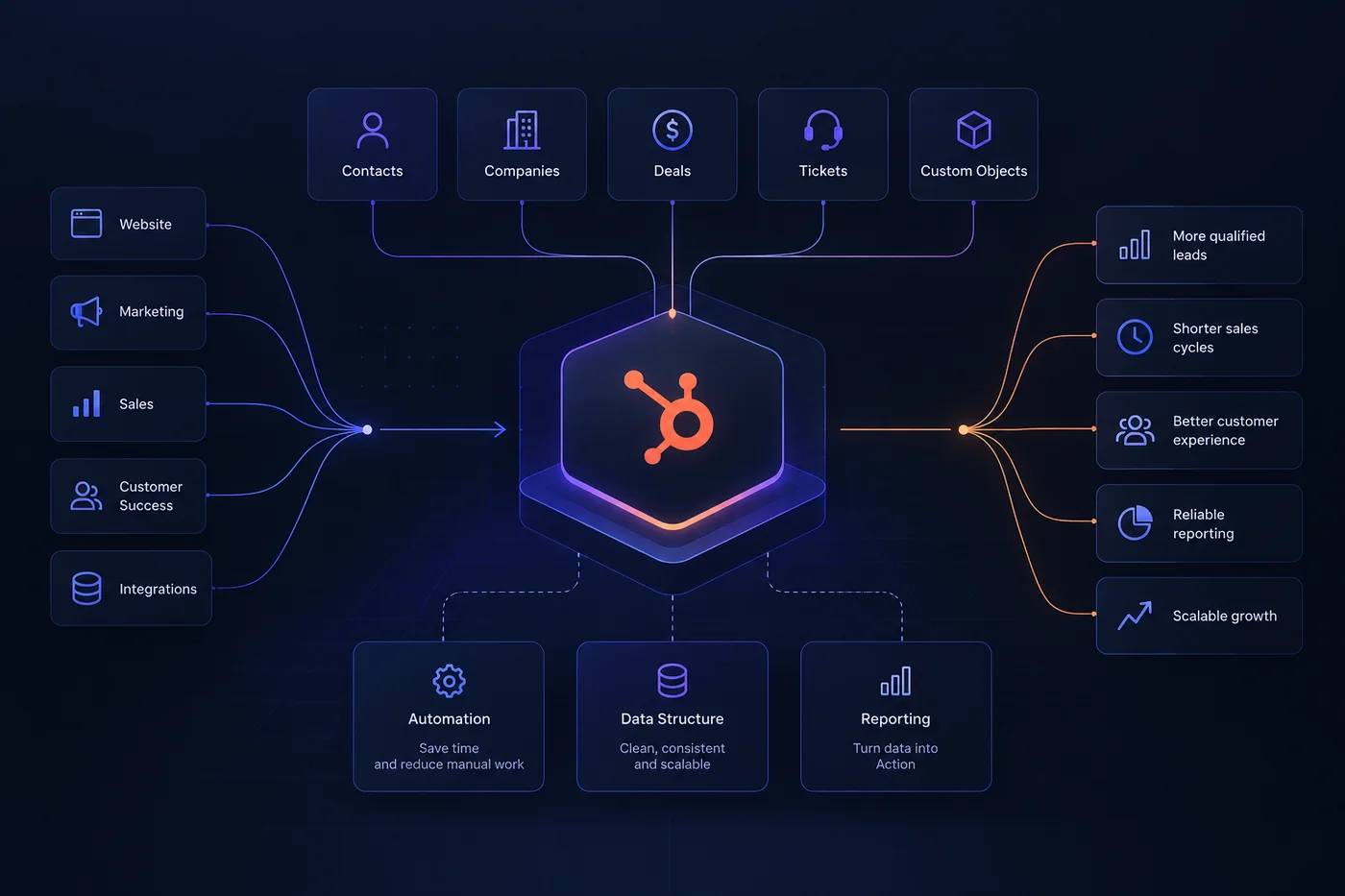
The short answer: use HubSpot for context and action
HubSpot can be a strong operating layer for SaaS marketing, sales and customer success when it receives the product and account context teams need to act.
It does not need to replace the product database. The important architecture decision is which system owns product truth and which customer signals should be available in HubSpot for segmentation, qualification, sales process, onboarding and retention.
Weavilo combines this SaaS perspective with HubSpot CRM architecture and implementation. The custom commerce platform case study shows how a HubSpot experience can work with a dedicated application layer, while the team page gives more context.
Model the customer and account relationship
SaaS businesses often need to relate people, companies, subscriptions, products, plans, environments, trials, opportunities and support activity. The model should reflect how the organisation sells and serves customers.
Start by deciding which concepts belong in HubSpot and which remain in the product or billing system. Then define associations, ownership, lifecycle stages and the properties required by marketing, sales and customer success.
A clear model prevents the CRM from filling with duplicate or ambiguous fields that no team can confidently use.
Bring in product signals that change decisions
Not every product event belongs in HubSpot. Useful signals are the ones that change a business decision or trigger a meaningful action.
- trial started, activated or approaching expiry,
- key feature or integration adopted,
- usage pattern indicating expansion or risk,
- subscription or billing state changed,
- onboarding milestone completed,
- support or success intervention required.
The integration should define how signals are aggregated, how long they remain useful and which team owns the resulting action. Raw event volume is not the same as customer insight.
Connect marketing, sales and customer success
HubSpot becomes more valuable when the lifecycle is designed across teams instead of treating each handoff as a separate automation.
Marketing may qualify demand, sales may use account and product context, and customer success may need onboarding, adoption or renewal signals. The system should make ownership and next steps visible at each transition.
Automation should support these processes with clear enrollment rules, controlled properties, useful notifications and reporting that distinguishes activity from real progress.
Measure the customer journey, not only lead volume
SaaS reporting needs to connect acquisition, qualification, pipeline, activation, adoption, retention and expansion where the available data supports those questions.
Before building dashboards, define which system owns each metric and how the metric is calculated. If revenue, subscription or usage data stays outside HubSpot, the reporting architecture should make that boundary explicit instead of creating a misleading copy.
The result should help teams decide what to do next: which accounts need attention, which channels create qualified demand and where the customer journey is losing momentum.
HOW WE APPROACH SAAS SYSTEMS
Separate responsibilities, connect the journey.
MODEL
Define customer, account and subscription concepts.
CONNECT
Bring useful product signals into the CRM.
AUTOMATE
Coordinate marketing, sales and customer success.
MEASURE
Report on lifecycle and commercial outcomes.
HubSpot should help teams understand and act on customer context while the product system remains responsible for product truth.