
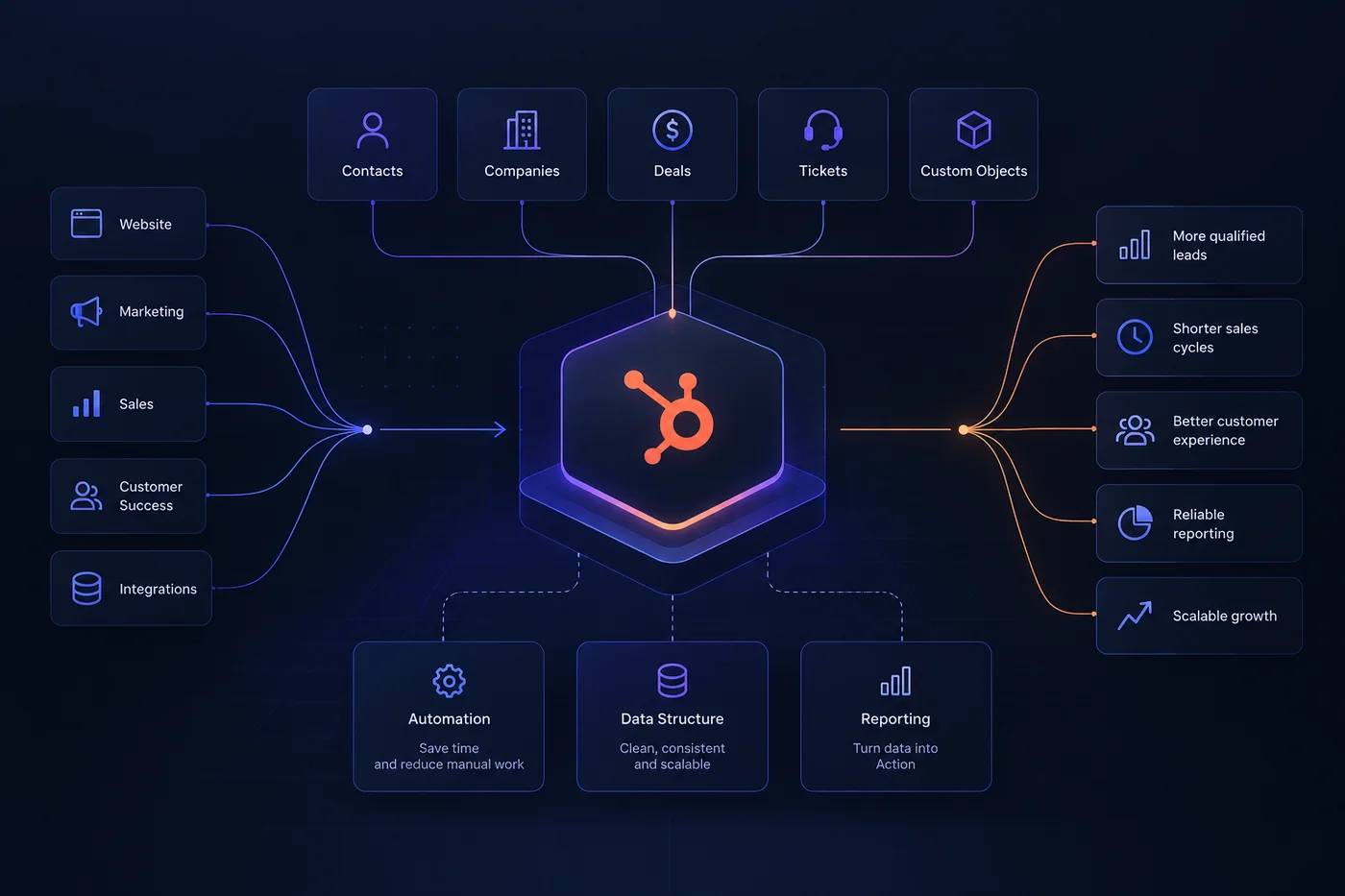
The short answer: start with the business system
A good HubSpot CRM implementation agency connects business architecture with technical delivery. It should understand how marketing, sales, service and operations work before creating properties, pipelines or workflows.
The output is not just a configured portal. It is a CRM structure with clear ownership, reliable data, useful automation, understandable reporting and a plan for future change.
Weavilo applies this approach across HubSpot agency projects, with background described on the About page and examples collected in the case studies.
Evaluate the architecture, not only the feature list
Most agencies can list the features they configure. The more important question is whether they can explain the decisions behind the configuration.
Ask how the agency handles:
- objects, associations and custom data models,
- property meaning, ownership and source of truth,
- lifecycle stages versus sales pipelines,
- workflow dependencies and re-enrolment,
- reporting requirements and data quality,
- permissions, testing and change management.
A portal can contain all the right HubSpot tools and still be difficult to trust if those relationships were never designed explicitly.
Check migration and integration capability
Implementation often includes more than setting up a new portal. Existing records, pipelines, websites, forms, ecommerce systems, APIs and internal tools may need to connect to the new architecture.
A capable agency should describe how it will audit source data, map objects and fields, handle duplicates, preserve important relationships, recreate automation and validate the result before launch.
For integrations, ask which system owns each value, which records need to move in each direction, how errors are surfaced and what happens when one system is unavailable. A connector without these rules can move inconsistent data faster.
Ask how delivery and handover work
Clear delivery is a strong signal of implementation quality. Before signing, ask for the expected stages, responsibilities, decision points, testing approach and handover materials.
The agency should be able to explain who will make architecture decisions, who configures the portal, how business users validate the system and how changes will be handled after launch.
Useful handover material includes a data model, naming conventions, workflow descriptions, integration ownership rules, reporting definitions and a list of known limitations. These documents reduce the risk of a system that only one external team understands.
Choose evidence that matches your project
Look for work that resembles the problem you need to solve. A simple sales pipeline setup is different from a CRM migration, a multi-team architecture, a SaaS lifecycle model or an integration-heavy implementation.
Review case studies for the original problem, the systems involved, the decisions made and the outcome. A useful case study explains what changed and why. It does not need to reveal confidential client information, but it should contain enough detail to show how the work was done.
Finally, choose an agency that can communicate clearly about trade-offs. The best design depends on the business model, existing systems, data quality, team ownership and the level of change the organisation can absorb.
HOW WE APPROACH IMPLEMENTATION
Architecture before configuration.
UNDERSTAND
Map the business processes, data and systems.
DESIGN
Define objects, ownership, lifecycle logic and integrations.
BUILD
Configure, migrate and automate the agreed structure.
HAND OVER
Validate the system and make the operating rules clear.
The implementation should leave the team with a CRM it can understand, operate and improve after the agency has finished the initial delivery.